Table distributions
In this page you will manage how guests are distributed into tables for the banquet. You will find several sections:
Tables available
In this component you can determine the size and amount of the tables that are available for the distribution. It is possible that the venue has a limited amount of tables of different sizes. If you don't specify an amount, the system will assume it can use tables of this kind on demand, or as many as needed.
The processing engine will try to respect the capacity boundaries of the tables, but this is not guaranteed. For example, say a table has a max capacity of 10 people, it may fit 11 people to compensate the discomfort of splitting a group of 11 people into halves, and mix them with other smaller groups. It is possible, though unlikely.
An error will be displayed if the table types configured don't have enough capacity to allocate all potential guests.
Distribution editor
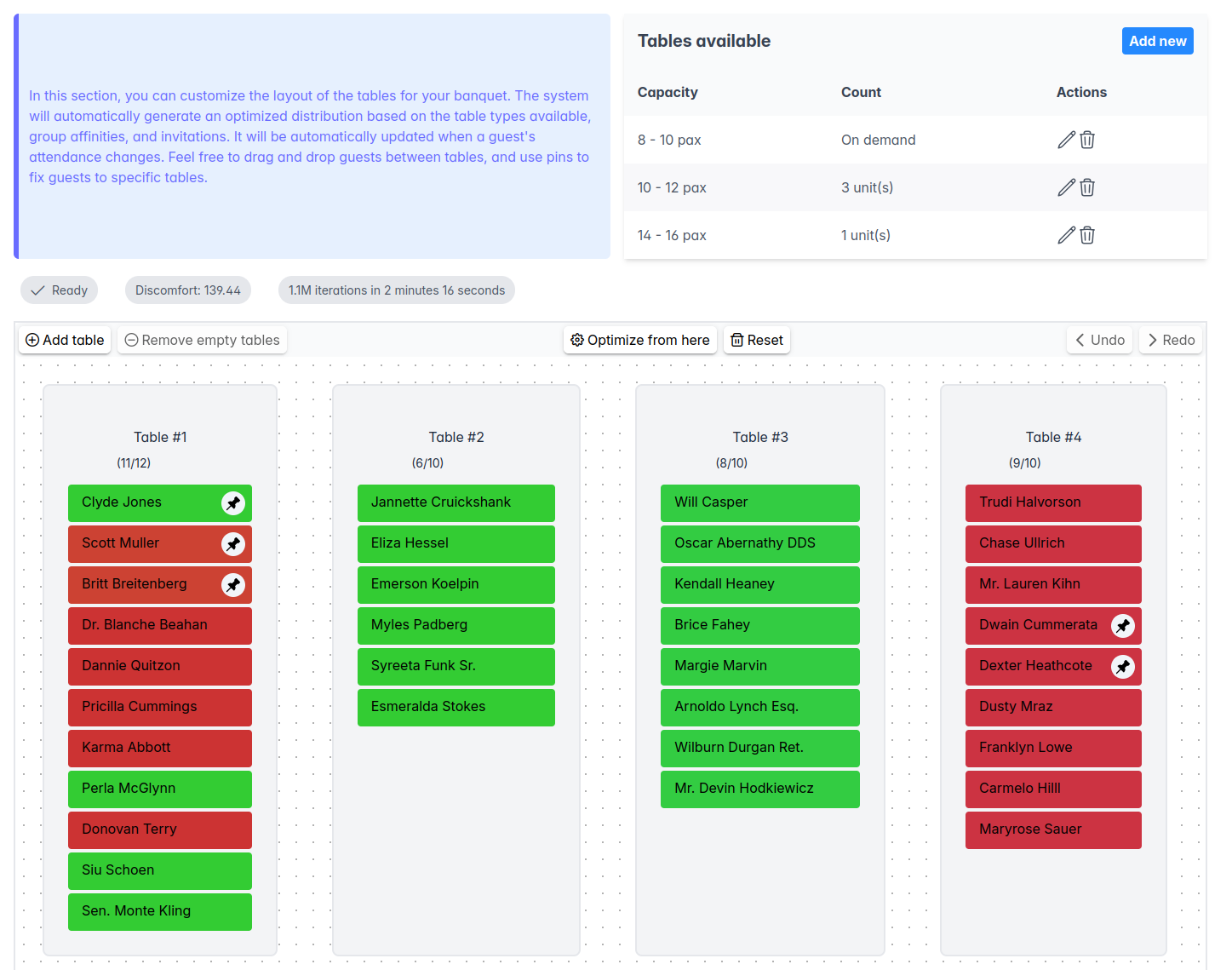
The system will automatically keep your simulation up-to-date with new events that could impact the solution (attendance changes, affinity changes, etc.). However, you can also rearrange guests the way better fits your need. Keep in mind that the system will re-arrange guests automatically, so you should use pins in case you want to guarantee that certain guests are bound to a certain table. Pinning too many guests to tables reduces the combinations available for the optimization engine to find new solutions.
Using the editor, you can:
- Move guests between tables, using drag-and-drop.
- Create an empty table.
- Remove empty table (in roadmap).
- Pin a guest to a table using the thumbtack icon revealed on hover. This ensures a guest is fixed to a table if the simulation is further optimized.
- Optimize from here. Request the system a new simulation starting from the current solution (after all user edits). Useful after making manual changes to the existing solution.
- Reset. Discard all changes and start over. Will use the latest table types configured, and remove all pins. This action is useful, for example, after changing the sizes or availabilities of table types.
- Undo/Redo (in roadmap), to navigate through the history of editions.